6 Best Hawk Eye Portable Fish Finder Models for Shore, Kayak and Boat (2026)
Compare six hawk eye portable fish finder options for shore, kayak and boat use. See key features, pros, cons and a buying guide to pick the right one.
 By Caleb Morgan
Updated November 21, 2026
 By Caleb Morgan
Updated November 2026
Anglers looking at a hawk eye portable fish finder usually want to know one thing fast: which model will show fish and bottom structure without a complicated setup? This list compares six portable units across the HawkEye line and similar handheld sonar sensors. Selection criteria include portability, display readability, battery life, transducer type, and how well each model suits shore, kayak or small boat use.
Best overall: HawkEye FishPod 5X – View on Amazon
Best for simple color display: HawkEye Fishtrax 1C – View on Amazon
Best for fish size and temperature readouts: Venterior Portable Rechargeable Fish Finder – View on Amazon
Best for kayak mounting: LUCKY Kayak Portable Fish Finder MT-202 – View on Amazon
Best for a larger screen on a boat: Garmin Striker 4 – View on Amazon
Best budget wireless option: LUCKYLAKER Sonar Kayak Fish Finder – View on Amazon
Our Top Picks
| Product | Best for | Key feature |
|---|---|---|
| HawkEye FishPod 5X | Overall portable use | Bluetooth and AI sonar |
| HawkEye Fishtrax 1C | Simple color display | HD Virtuview screen |
| Venterior Portable Rechargeable Fish Finder | Fish size readouts | Temperature and bottom contour |
| LUCKY Kayak Portable Fish Finder MT-202 | Kayak mounting | Wireless transducer |
| Garmin Striker 4 | Boat use with larger screen | 3.5-inch CHIRP display |
| LUCKYLAKER Sonar Kayak Fish Finder | Budget wireless setup | Handheld sonar with LCD |
HawkEye FishPod 5X Portable Bluetooth Fish Finder with AI Technology
HawkEye FishPod 5X Portable Bluetooth Fish Finder with AI Technology
Best for: Overall portable use across shore and small boats.
This model suits anglers who want a compact sensor that pairs with a phone and gives quick depth and fish-arch information without a separate head unit.
Pros
- Bluetooth connection to a phone app
- Compact enough to carry in one hand
Cons
- Phone battery use can add up on long trips
HawkEye Fishtrax 1C Fish Finder with HD Color Virtuview Display

HawkEye Fishtrax 1C Fish Finder with HD Color Virtuview Display, Black/Red, 2" H x 1.6" W Screen Size
Best for: Simple color display with a stand-alone unit.
Anglers who prefer a dedicated screen over a phone will find this model straightforward, with a small color display that shows depth and fish returns clearly.
Pros
- Stand-alone screen with no phone required
- Color display is easy to read in daylight
Cons
- Small 2-inch by 1.6-inch screen limits detail
Venterior Portable Rechargeable Fish Finder Wireless Sonar Sensor Fishfinder

Venterior Portable Rechargeable Fish Finder Wireless Sonar Sensor Fishfinder Depth Locator with Fish Size, Temperature, Bottom Contour, Color Display
Best for: Fish size and temperature readouts.
This wireless sensor suits shore anglers and bank fishermen who want temperature and bottom contour data without wiring a transducer to a boat.
Pros
- Shows fish size and water temperature
- Rechargeable with a wireless sensor
Cons
- Range depends on water conditions and clutter
LUCKY Kayak Portable Fish Finder Transducer Wireless Sonar MT-202
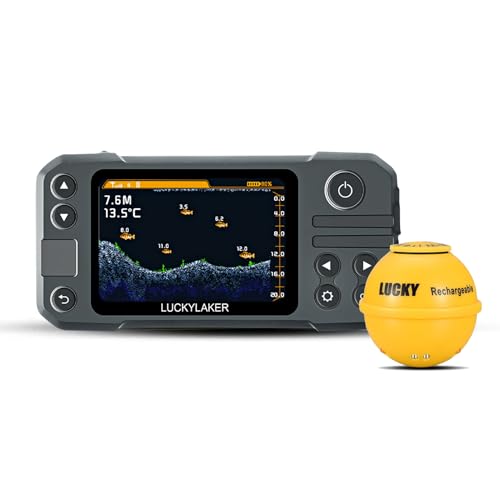
LUCKY Kayak Portable Fish Finder Transducer Wireless Sonar Fish Finders Boat Rechargeable Handheld Fish Depth Finder Fishing MT-202
Best for: Kayak mounting and wireless transducer setups.
Kayak anglers who need a light, wireless transducer that can clip or mount to a hull will find this model fits the job.
Pros
- Wireless transducer reduces cable clutter
- Designed with kayak mounting in mind
Cons
- Mounting hardware may need to be purchased separately
Garmin 010-01550-00 Striker 4 with Transducer, 3.5″ GPS Fishfinder with Chirp

Garmin 010-01550-00 Striker 4 with Transducer, 3.5" GPS Fishfinder with Chirp
Best for: Boat use with a larger screen.
Boat anglers who want a dedicated GPS fishfinder with CHIRP sonar and a readable display will find this model fits a range of small boat setups.
Pros
- 3.5-inch display with GPS and CHIRP sonar
- Transducer included in the package
Cons
- Not a handheld unit, so less suited to shore use
LUCKYLAKER Sonar Kayak Fish Finder Portable Water Handheld Depth Finder

LUCKYLAKER Sonar Kayak Fish Finder Portable Water Handheld Depth Finder Boat Transducer Wireless Fish Finders Sea LCD Screen Fishing
Best for: Budget wireless setup.
Anglers on a tight budget who want a handheld sonar with an LCD screen for kayak or shore use will find this a practical starting point.
Pros
- Handheld with a wireless transducer
- Simple LCD display for depth readings
Cons
- Fewer features than premium models
Buying Guide
Portability and Mounting
Weight and mounting style matter most for shore and kayak use. Check whether the unit is handheld, clips to a rail, or needs a bracket.
Display Readability
Screen size and color affect how quickly you can read fish arches and bottom contour in bright sun. Larger screens help on boats, while small screens work for quick depth checks.
FAQ
Can a hawk eye portable fish finder work from shore?
Yes, many handheld units are designed to be cast or lowered from shore, a dock, or a pier. Shore use works best when the transducer can be placed in open water near the spot you want to read. Check the cable or wireless range before you buy so you know how far out you can reach.
What is the difference between a wireless and a wired portable fish finder?
Wireless models send sonar data to a handheld display, which makes them easy to use from a kayak or while casting. Wired units tie the transducer to the display and are often more stable, but they limit where you can move. For most portable setups, wireless is the more flexible choice.
Do I need a transducer mounted on the boat to use these models?
Not always. Many portable units use a standalone transducer that you drop into the water on a line or pole. Fixed-mount models, like some Garmin units, are better suited to permanent installation on a boat.
How do I know if a fish finder will work in shallow water?
Look for units that list a shallow-water depth range and show bottom contour clearly. Shallow water can cause sonar to show surface clutter, so a unit with adjustable sensitivity helps. Testing the settings in the water you usually fish is the best way to confirm performance.
Is a color display important for a portable fish finder?
A color display can make fish arches, bottom hardness, and depth changes easier to read, especially in bright sunlight. Monochrome screens can still work well and often use less battery. Choose based on how you plan to view the screen and how long you expect to run it.
How should I charge and store a portable fish finder?
Charge the display and transducer fully before each trip, and keep the unit out of extreme heat or freezing conditions. Rinse the transducer with fresh water after saltwater use and store the display in a dry bag or case. Following the manufacturer’s care steps helps the battery and sensor last longer.
Conclusion
If you want an easy, all-around pick for shore, kayak, or small boat trips, the HawkEye FishPod 5X is the most versatile choice in this list. Anglers who value a simple color screen and quick setup will likely be happiest with the HawkEye Fishtrax 1C.
For readouts on fish size and temperature, the Venterior model is worth a look, while the Garmin Striker 4 suits boaters who want a more permanent, feature-rich installation. Match the unit to where you fish most often, and you will get the most value from your purchase.
Related reading
- Top 5 Portable Fish Finder Depth Finder Picks for Shore, Kayak and Boat
- Sonar Fish Finder Portable (2026): Which Should You Choose?
- 6 Best Venterior Portable Fish Finder Options for Shore and Boat (2026)
- Yakattack Fish Finder Mount: 5 Best Picks Compared (2026)
- Xubbwov Striped Bass Rigs Review: Fish Finder Rig for Striped Bass
- What Is a Transducer on a Fish Finder? Transducer vs Display (2026)
About Caleb Morgan
Caleb Morgan is part of our editorial team and reviews and edits our saltwater fishing guides, checking product details against manufacturer specifications and owner feedback.
About the author
Caleb Morgan writes reviews and buying guides for Saltwater Fishing.