Lowrance Fish Finder Elite 4 Review: Features and Performance
Lowrance fish finder Elite 4 review covering features, specs, pros and cons, and who should buy it, plus alternatives to compare before you decide.
 By Caleb Morgan
Updated November 24, 2026
 By Caleb Morgan
Updated November 2026
The lowrance fish finder elite 4 is aimed at anglers who want a clear, capable sonar display without stepping up to a large, premium chartplotter. It suits small boat owners, kayak anglers, and weekend fishermen who mostly fish inshore or nearshore and want a simple unit they can set up quickly. It is a weaker fit for offshore anglers who need large screens, advanced mapping, or multiple networked displays, and for anglers who want the newest CHIRP-focused features on a bigger screen. Read on for specifications, owner feedback patterns, and a buying guide so you can check whether this unit fits your boat and fishing style.
Lowrance Elite FS 9 Fish Finder with Active Imaging 3-in-1 Transducer, Preloaded C-MAP Contour+ Charts
Product Overview
The Lowrance Elite FS 9 is the product this review covers, and it is the model sold on Amazon under the listing that includes an Active Imaging 3-in-1 transducer and preloaded C-MAP Contour+ charts. Lowrance, a long-established name in marine electronics, builds the Elite line as a mid-range series between its entry-level Hook units and its higher-end Elite and HDS models. Searchers looking for the lowrance fish finder elite 4 name are often comparing this family of Elite units, so it helps to understand where this specific listing sits within that lineup.
The FS designation indicates a fishfinder/chartplotter combination, meaning the unit can both display sonar returns and show navigation charts. The bundled Active Imaging 3-in-1 transducer is designed to deliver several imaging modes from a single transducer, which is a major reason owners choose this package over buying a separate transducer. Preloaded C-MAP Contour+ charts add depth contour and navigation information out of the box, though coverage depends on the region you fish.
Because the product name and the keyword refer to a fish finder in the Elite family, buyers should confirm the exact model number on the listing before purchase. Lowrance has released several Elite variants with similar naming, and the screen size, transducer bundle, and chart coverage differ between them.
Key Features & Specifications
The table below lists features that the product name and its listing description state directly. Where a detail is not clearly published, it is left out rather than guessed at. Always check the current manufacturer page for exact dimensions, resolution, and power draw before you mount the unit.
| Feature | Details |
|---|---|
| Product type | Fish finder with chartplotter functionality (FS series) |
| Transducer | Active Imaging 3-in-1 transducer included |
| Charts | Preloaded C-MAP Contour+ charts |
| Sonar imaging | Active Imaging for detailed underwater views |
| Brand | Lowrance (Elite line) |
Buyers should look up the official screen size, resolution, mounting dimensions, and input voltage on Lowrance’s product page, since those specifications vary by model and are not reproduced here.
Pros & Cons
Pros
- Bundles the Active Imaging 3-in-1 transducer, so the sonar setup is ready from the start.
- Includes preloaded C-MAP Contour+ charts for navigation and depth reference.
- Combines fish finding and chartplotting in one unit, which reduces the number of displays on a small boat.
- Carries the Lowrance Elite name, which is widely supported by aftermarket accessories and dealer networks.
- Suits a range of boats where a full-size networked system would be more than the owner needs.
Cons
- Chart coverage is tied to the included C-MAP region, so anglers fishing outside that area may need additional cartography.
- Owners who want the newest CHIRP-focused tools on a larger display may prefer a higher Elite or HDS model.
- Sonar and imaging results depend heavily on transducer mounting angle, water conditions, and correct setup.
- Smaller-screen units can be harder to read in bright sunlight without a sunshade or proper positioning.
Performance Analysis
Performance for a fish finder depends on three things: the transducer, the screen, and the user’s setup. The bundled Active Imaging transducer is the main reason owners buy this package, because it allows several imaging views from one mount. Owner feedback patterns for Elite-series units generally focus on clear bottom definition and useful fish arch display in shallow to moderate depths, while noting that results in deep or turbulent water can be less consistent.
Owners often report that the unit works best when the transducer is mounted cleanly, with the face parallel to the water surface and free of air bubbles. Improper mounting is one of the most frequently cited reasons for disappointing sonar, so take time to set the transducer height and angle before fishing. Chart performance is generally considered adequate for navigation and depth awareness, though anglers who depend on detailed high-resolution mapping in unfamiliar waters may want to supplement it.
In terms of day-to-day use, the unit is best suited to inshore flats, nearshore structure, freshwater lakes, and small-boat applications. For deep offshore work, a larger screen and more advanced sonar options are usually a better match.
Who Should Buy This Product?
This unit fits anglers who want a complete sonar and chart package in one purchase, especially on small to mid-size boats. Owners who fish mostly inshore or on lakes will likely find the feature set matches their needs. Kayak and small-skiff anglers who want a clear display without a large investment are also a good audience.
It is less suitable for anglers who need a large, high-resolution screen for offshore runs, anyone who plans to run multiple networked displays, or those who fish regularly outside the C-MAP coverage area. In those cases, one of the higher-tier Lowrance models will serve better. If you are unsure of your needs, consult a marine electronics dealer who can review your boat and fishing grounds.
Buying Guide
Before buying any fish finder, work through a short checklist. First, confirm the screen size fits your console or helm, and measure the mounting space including the depth the head unit needs behind the panel. Second, decide whether you need a transducer bundle or already have a compatible one. Third, check chart coverage for the waters you fish most often, since a preloaded chart is only useful inside its region. Fourth, consider power requirements and whether your boat’s electrical system can support the unit reliably.
Several well-known alternatives are worth comparing if this model does not match your needs. The Lowrance Eagle 4X offers a smaller 4-inch display with bullet transducer and autotuning sonar, making it a practical choice for compact boats. For anglers who want a larger screen and more imaging options, the Lowrance Eagle 5 SplitShot HD includes a 5-inch IPS display, CHIRP and DownScan with FishReveal, and Genesis Live mapping.
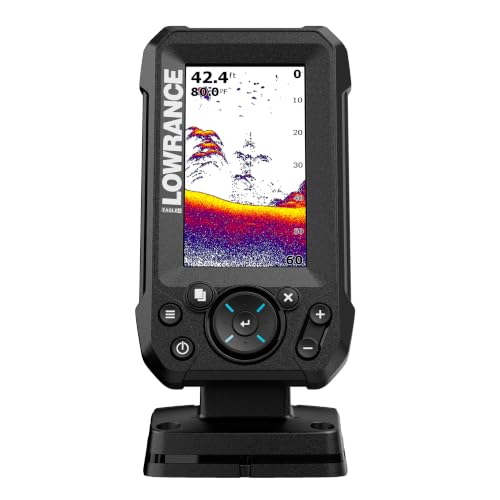
Lowrance Eagle 4X Fish Finder with Bullet Transducer | 4-inch IPS Display; wide-angle sonar coverage; autotuning sonar; easy twist-lock connector

Lowrance Eagle 5 SplitShot HD Fish Finder with C-MAP Inland Charts | 5-inch IPS Display; CHIRP and DownScan with FishReveal; autotuning sonar; Genesis Live mapping; easy twist-lock connector
If you are still deciding between sizes and features, these related guides on the site can help you narrow the field: Lowrance Elite-5 Fish Finder Review: Features and Performance, Lowrance Elite FS 9 Fish Finder Review: Key Features Explained, 5 Best Lowrance Elite 4X CHIRP Fish Finder Models Compared (2026), and What Is Chirp on a Fish Finder? CHIRP vs Standard Sonar (2026). For transducer basics, see What Is a Transducer on a Fish Finder? Transducer vs Display (2026), and for mounting ideas on small boats, read Yakattack Fish Finder Mount: 5 Best Picks Compared (2026).
FAQ
Is the lowrance fish finder elite 4 good for beginners?
It can be, because the bundled transducer and preloaded charts reduce the number of separate purchases needed to get started. Beginners should still spend time learning how sonar images map to bottom structure and fish arches, and should follow the manufacturer’s mounting instructions closely.
Does this unit include a transducer?
Yes. The listing for this model includes the Active Imaging 3-in-1 transducer, so you do not need to buy one separately. Confirm the included parts on the listing before ordering.
Are the charts usable outside the United States?
The preloaded C-MAP Contour+ charts are tied to specific regional coverage. Check the chart coverage map on the manufacturer or C-MAP site before assuming it will work in your fishing area.
Can I mount this fish finder on a kayak?
Many anglers use Lowrance units on kayaks, but the head unit’s size, power needs, and mounting options matter. A dedicated kayak mount and a battery sized for the unit are important, and the related guide on kayak mounts can help you compare options.
How does Active Imaging differ from standard sonar?
Active Imaging is Lowrance’s branded name for high-resolution sonar imaging that displays underwater structure and targets in more detail than traditional down-looking sonar alone. Results still depend on water conditions, depth, and correct transducer setup.
Do I need a separate GPS antenna?
Most chartplotter-enabled Lowrance units include GPS capability internally, but you should confirm this on the official specifications for your exact model. Mounting location matters for a clear GPS signal.
Is professional installation recommended?
Installation is manageable for many boaters, but a marine electrician or certified dealer can help with wiring, transducer placement, and power protection. If you are unsure about any electrical step, consult a qualified professional.
Final Verdict
The Lowrance Elite FS 9 with Active Imaging 3-in-1 transducer and preloaded C-MAP Contour+ charts is a practical choice for anglers who want a complete sonar and chart package on a small to mid-size boat. Its bundled transducer and charts make setup straightforward, and it covers inshore, nearshore, and freshwater fishing well. Buyers who need a larger screen, broader chart coverage, or advanced offshore features should compare the higher Elite and HDS models before committing.
View on AmazonBefore you buy: helpful guides
About Caleb Morgan
Caleb Morgan is part of our editorial team and reviews and edits our saltwater fishing guides, checking product details against manufacturer specifications and owner feedback.
About the author
Caleb Morgan writes reviews and buying guides for Saltwater Fishing.